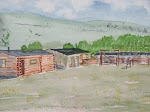
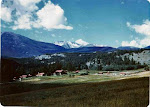
As I mentioned in a previous post, the daily trail ride was the featured attraction at the pitchfork dude ranch. Often times two rides were available ~ one in the morning and another in the afternoon. They were
hugely popular with the under forty crowd and their young families. The weekly cook out ride to the beaver dams on Timber creek and the Indian Tepee rides were favorites with the quests and me; and will always be a treasure in my boyhood bag of memories.
The weekly cook out ride was about a three mile trail ride up the Timber creek drainage complete with pack horses (not always including the "red rooster") loaded with bar-b-que equipment, steaks, and all the trimmings. I remember one year in particular because we had to navigate our way through a pasture containing a bunch of mules at the ranger station which was about a half a mile above the ranch. This was about 1946 when forest fire crews were still supplied basically by pack trains. The ranger station above the ranch had a contract to break to pack about 40 head of government mules. I remember how huge they were and how unbelievably large their heads were. They were the most curious animal around and would come a running to converse with the horses that we were riding. Unfortunately, the horses didn't always appreciate all the "mule conversation" and kicking fights would break out. We were always concerned that someone would be injured in the frays that occasionally arose. I do not recall any serious injuries, but do recall a few bruised shin bones that resulted from errant mule kicks. Damn those mules could kick. Looking back we were really fortunate that no one was seriously injured. Had our current litigious environment existed back then, Dad would have been sued for "reckless endangerment"! As it was, everyone just considered it a part of the "adventure".

Once we made it to the beaver dams, Dad and the wranglers would set up the camp site and prepare a chuck wagon dinner while the guests would have "cocktails" and watch the antics of the beavers. I do remember the trade off involved relative to the need for silence with the natural effects of having cocktails, i.e the tenancy to talk loud. I learned early the calculus of optimization, i.e. where the need to talk line crossed the need for silence. The only variable that could be controlled was the amount of booze consumed so Dad would pack only so much thus ensuring a successful beaver watch. I learned also that you can make dang near anything taste good if you starve them long enough. Although, in all honesty, the food was really good, but tasted even better because of how hungry we would be. The ride back was always in the dark which really made for an interesting ride the year we have to traverse the mule pasture! On full moon nights the ride back to the ranch was beyond belief. I remember on most rides back to the ranch we would have sing-a-longs. How I loved to sing! When the folk song scene of the sixties arrived I was ready! The sons of the pioneers and the Texas Playboys had prepared me well!
As a young boy I was most impressed with the three rides that we took to abandoned Indian camps. We had one encampment South of the ranch and one to the North. During the last year we were at the ranch, we just per chance found one next to Timber creek about a mile to the West of the ranch ~ this was the largest and best preserved of all the sites. All of the sites were the abandoned camp sites of Native Americans who were described as the "sheep-eaters" who I learned later were a branch group of Indians from the Shoshone tribe. See http://www.windriverhistory.org/exhibits/sheeptrunk/Sheep%20Eater%20Text.pdf for an excellent description of these native people. Apparently they did not travel in large groups probably not numbering more than 50 people at a time so the camp sites that we traveled to only had a maximum of probably six to eight tepees. Our visits to the camps started in 1945 so the tepees (wickiups) were probably only 30 to 40 years from being occupied. Each of the camps had at least a couple of wikiups that were still standing.

In the above pdf file the photo at the left is shown. It is a picture of Bob Edgar in front of a well preserved wickiup. Photo by Ron Mamot. I'm sure the photo was taken about the same time my family was at the Pitchfork. I actually seem to recognize Bob Edgar. However, I remember the wickiups as being much larger than the one shown on the left. However, I was only seven years old so everything seemed large to me at the time. When I returned to the ranch about twenty years ago, even the main lodge seemed smaller than my memories. Unfortunately, none of the other buildings remained and only the burned out remains of the lodge were visible.
I quote the above mentioned study,
Because they followed their food sources, the need for permanent housing was not a priority of the Sheep Eaters. Many times they would utilize the natural shelters in their locale such as cliff overhangs or caves both of which could be sealed or closed with either brush or hides (The Wind River Rendezvou, Vol. XX, 4).The Sheep Eaters also constructed structures known as wickiups for a more secure winter home while in the lower elevations. These wickiups were constructed in a wooden pole configuration which took on a conical shape. Many times brush and domed willow were also used in their construction. Once the wood or brush was in place, the wickiup was then often covered with tree bark slabs, animal hides, or sheaves of grass tied together with willow. These structures were usually ten to fifteen feet in diameter and were occupied by two families (Janetski 46).
Usually upon their return from the higher elevations, the Sheep Eater family only needed to make minor repairs to prepare the wickiup for the harsh winter months.As I mentioned above, several of the wickiups were still intact when we visited them in 1945-1950. I remember finding arrow heads and other artifacts while poking around in the fire pits that were still obvious in the camp sites. According to the above quoted study, the sheep eaters would spend the Summers in the Yellowstone park area and would Winter in the lower elevations in the Absaroka mountain range near the ranch. My imagination would run wild as I sat in the tepees and envisioned war parties, hunting parties and fireside councils!. At seventy, I look at the picture of the wickiup and wonder how in the hell they stooped enough to get through the door way and how hard that ground must have been. I wonder if they had cpac machines to help with the snoring problem. :-)
I often wonder if I would be able to find any of the sites if I were to return. One in particular, I believe I could get close to but doubt if I could actually find it. Time not only diminishes our memories but changes the landscape as well.
Gordon et. al.


 As I mentioned in a previous post, the daily trail ride was the featured attraction at the pitchfork dude ranch. Often times two rides were available ~ one in the morning and another in the afternoon. They were hugely popular with the under forty crowd and their young families. The weekly cook out ride to the beaver dams on Timber creek and the Indian Tepee rides were favorites with the quests and me; and will always be a treasure in my boyhood bag of memories.
 In the above pdf file the photo at the left is shown. It is a picture of Bob Edgar in front of a well preserved wickiup. Photo by Ron Mamot. I'm sure the photo was taken about the same time my family was at the Pitchfork. I actually seem to recognize Bob Edgar. However, I remember the wickiups as being much larger than the one shown on the left. However, I was only seven years old so everything seemed large to me at the time. When I returned to the ranch about twenty years ago, even the main lodge seemed smaller than my memories. Unfortunately, none of the other buildings remained and only the burned out remains of the lodge were visible.